
Cities at the Crossroads
Subnational engagement and the next frontier of democratic security: a strategic brief on why cities and states have become frontline democratic infrastructure.
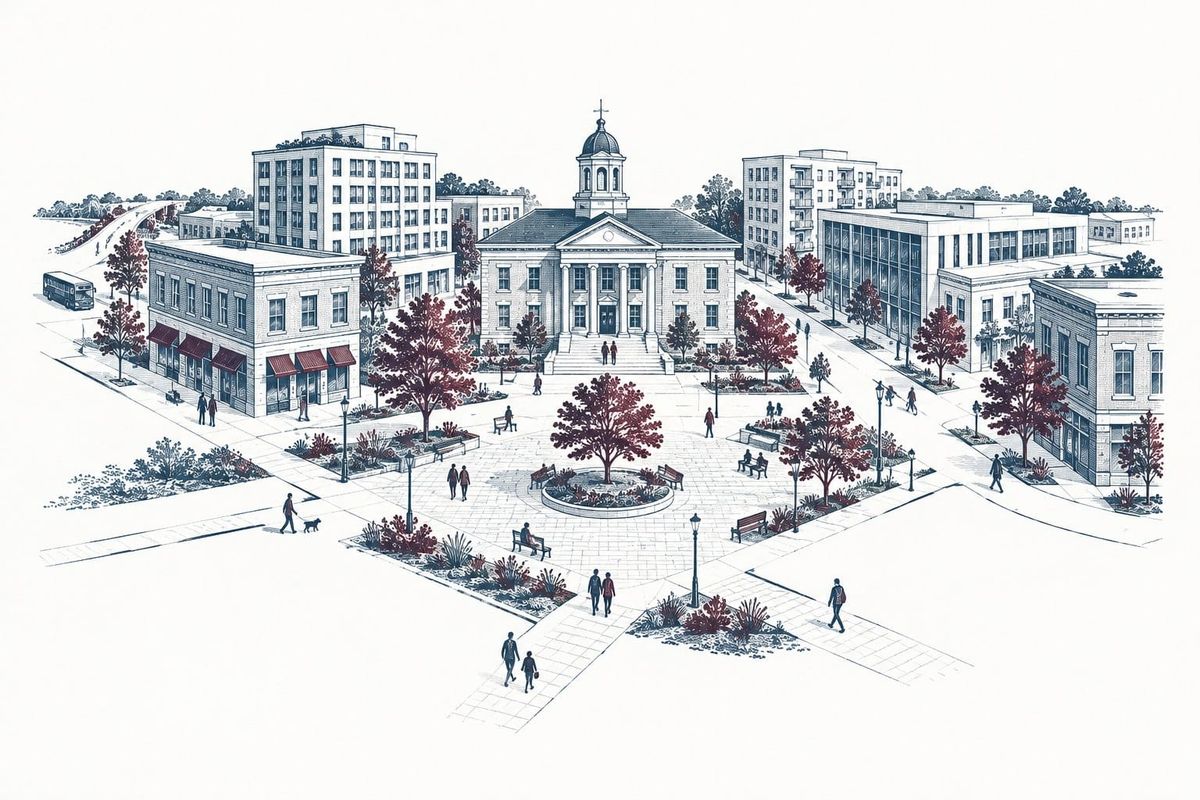
Strategic Brief · Democratic Resilience
Download the PDF Read online ↓
This brief is published as completed in April 2025. Its sources and examples reflect that date.
Context
As global power competition intensifies and democratic norms are tested within countries once thought unshakable in their foundational ideals, cities are emerging not only as sites of policy implementation but as operational terrain in the struggle for democracy’s future. Recent decades have seen a global uptick in democratic backsliding and authoritarian resurgence—marked by such shifts as erosions of institutional norms, increasing civic disengagement, and weakened transnational cooperation.1 These shifts have exposed fault lines even within long-established democracies. From disinformation campaigns to executive overreach and economic coercion, actors both domestic and transnational are increasingly targeting local institutions to weaken cohesion, exploit vulnerabilities, and erode public trust.
Democratic backsliding often manifests nationally through executive overreach, policy inconsistency, or the attrition of key federal agencies—leaving gaps that municipalities are increasingly forced to fill. Subnational governments have stepped into roles once assumed by many to be the purview of national oversight: mitigating the potential for crisis and planning responses accordingly, building transnational alliances, and navigating geopolitical pressures traditionally reserved for national authorities.2
These dynamics reveal an urgent truth: subnational actors are no longer peripheral to national security—they are foundational to its long-term resilience.3 Yet they often operate without sufficient strategy, coordination, or recognition of their emerging role within the broader democratic security landscape.
This brief examines subnational engagement as a core pillar of democratic infrastructure, highlighting both the vulnerabilities cities face and their potential to strengthen democratic resilience.
Subnational Governments as Strategic Democratic Infrastructure
Cities and states are increasingly engaging in what might once have been considered federal territory: foreign policy coordination, national security resilience, and international partnership development.4,5 In the absence of consistent federal leadership—or in the presence of deliberate destabilization—these actors are shaping policy, forging global ties, and defending democratic values at the ground level.
This expansion of subnational agency is not accidental; it is reactive and adaptive. In many cases, local governments are addressing threats—cyberattacks, disinformation, coercive investment—without being fully integrated into national frameworks or provided access to strategic resources.6
The result is an uneven patchwork of resilience. Some jurisdictions have established sophisticated international offices and narrative strategies. Others are navigating authoritarian encroachment, economic dependency, and ideological polarization with little to no guidance. Without a unifying framework, these efforts remain fragmented and reactive, leaving the broader democratic ecosystem exposed.
Cities as Operational Arenas and Influence Targets
The modern city functions not only as a service provider but as a symbol, an engine of human connection, and a node in global influence operations. This makes cities uniquely attractive to authoritarian regimes and transnational extremist movements, which often seek to exploit existing fissures in civic trust or institutional legitimacy.5,7
Emerging threat vectors increasingly target cities as points of entry for democratic destabilization. These efforts are not hypothetical—they are evolving in real time, and their implications reach far beyond any single jurisdiction.6
Tactics include:
- Cyber intrusions targeting public infrastructure and municipal databases.
- Narrative manipulation via local social media, cultural channels, and diaspora communities.
- Strategic economic investment designed to influence long-term city planning and resource allocation.
- Disinformation campaigns that weaponize local grievances or policy missteps to amplify division.
These approaches are opportunistic. Cities with weakened institutions, stymied or reduced federal funding, strained public trust, or poor public communication are more susceptible to external interference—particularly when national coordination mechanisms are absent or politicized.
Figure 1 / Illustrative examples
Where wider pressures meet local choices
| Pressure | Local arena | A question to ask |
|---|---|---|
| Disinformation | Elections and public forums | Who can verify information and share it with residents? |
| Centralized authority | Local planning and funding | Where do decisions and resources sit? |
| Investment and technology | Procurement and infrastructure | What dependencies and safeguards need review? |
Implications for Democratic Resilience and National Security Strategy
When subnational actors are forced to operate in the absence of strategic guidance and federal partners whose credibility and symbols of trust have shown weakness, the implications extend far beyond the local landscape. Democratic instability grows from endemic to systemic, and national security is compromised.
- National security blind spots will deepen, particularly where federal intelligence fails to reach or coordinate with local governments.7
- Narrative vacuums will be filled by actors with anti-democratic aims, further eroding trust in public institutions.
- Reactive governance will be normalized, reducing the capacity for long-term democratic planning and partnership development.
Yet the same spaces being targeted can become strategic anchors of defense. Cities and counties are often more trusted by residents,5 more responsive in moments of crisis, and more embedded in daily life. With the right tools and frameworks, they can counteract destabilization efforts and reinforce democratic stability from the ground up.
Clarifying the Strategic Role: Subnational Engagement vs. Subnational Diplomacy
As the roles of local governments continue to blend into the spheres of national security, public trust, and geopolitical resilience, it is important to distinguish between subnational diplomacy and subnational engagement. The former refers to the outward-facing international relationships that cities and states increasingly pursue—such as global partnerships, climate coalitions, or humanitarian advocacy.5 Subnational engagement, by contrast, refers to the internal, regional, and federal strategic posture of local governments as civic stabilizers, narrative stewards, and early warning nodes within the national security ecosystem.8
Subnational engagement is also the pillar under which subnational diplomacy is most sustainably practiced. In ideal circumstances, such engagement should inform both domestic and foreign policy decisions, grounding them in the lived experience and contextual expertise of those most affected by federal decision-making.
Where diplomacy projects values across borders, engagement ensures those values are rooted at home. This distinction—developed through ongoing work at the intersection of local governance, resilience planning, and national strategy—helps clarify the layered role that subnational actors now play in democratic continuity. Initiatives inspired by this framing have begun exploring how cities can contribute not only to foreign policy dialogues, but to coordinated domestic resilience efforts grounded in public trust, policy visibility, and strategic alignment.9
Figure 2 / Conceptual distinction
Engagement and diplomacy: related, not identical
Subnational engagement
Within and between levels of government
Connect local knowledge, planning, and coordination with state and national decisions.
Subnational diplomacy
Across national borders
Cities and states build international partnerships and participate in global networks.
To translate this clarity into impact, local, national, and international partners must now treat subnational engagement not as a peripheral concern—but as a strategic lever for democratic resilience and national security.
Strategic Recommendations
To fortify democratic infrastructure and support effective coordination across government levels, institutions and policymakers should:
- Formally integrate subnational actors into national security, foreign policy, and civic resilience planning. Create sustained mechanisms for intelligence sharing, interagency briefings, and joint contingency planning with city and state governments.2,10
- Institutionalize strategic communications as a core public-sector competency. Invest in local narrative infrastructure—training and/or forming partnerships with trusted messengers, countering disinformation, and equipping subnational leaders to proactively shape public understanding during periods of democratic stress.7,9
- Support multilevel coordination platforms that center local expertise. Build upon communications frameworks that not only establish pipelines of trust within communities, but infuse resiliency planning with the lived constituent experience, much like Indonesia’s I-KHub or other regional resilience hubs that embed local knowledge into national frameworks.11
- Fund and facilitate cross-sector civic coalitions. Leverage the connective power of community-building by engaging and convening civil society, academia, and faith leaders around shared resilience priorities that extend beyond electoral cycles.1
- Strengthen support for applied research, training, and leadership development that reflects the layered civic and security roles of local governments. Encourage philanthropic, academic, and intergovernmental investment in developing subnational engagement as an emerging field of practice—one rooted in trust, adaptability, and coordinated democratic defense.
Conclusion
The threats facing democratic societies today are not limited to capitals and federal ministries—they are playing out in school board meetings, city planning offices, and municipal procurement decisions. Meanwhile, an increasing number of subnational actors are finding themselves drawn into geopolitical orbits once considered far beyond their remit—often without the standards, coordination, or knowledge exchange needed to support them.
Subnational engagement can no longer be treated as discretionary. It is a strategic necessity. Institutions that fail to invest in this layer of governance will face escalating vulnerability. Those that do will strengthen the connective tissue essential to democratic resilience—and help ensure that the defense of democracy is not confined to the top, but rooted deeply in every level of public life.
Sources
- Shein, Erica, and Cassandra Emmons. Paths to Democratic Resilience in an Era of Backsliding: A Roadmap for the Democracy Support Community. International Foundation for Electoral Systems, November 2023. ifes.org
- O’Hanlon, Michael. The Role of State and Local Governments in Homeland Security. Written testimony for the U.S. Senate Committee on Homeland Security and Governmental Affairs, July 14, 2005. Brookings Institution. brookings.edu
- Odierno, Raymond, and Michael O’Hanlon. Urban Security Is National Security. Brookings Institution, March 16, 2017. brookings.edu
- Kaufman, Kristen Edgreen. As the U.S. Abandons Its Allies Abroad, Cities and States Can Save International Relations. Forbes, March 19, 2025. forbes.com
- Bouchet, Max. The Influence of Strategic Subnational Diplomacy in International Relations. Ifri Memos, French Institute of International Relations (Ifri), September 16, 2024. ifri.org
- Ljungkvist, Kristin. Security in the Age of Cities. 2018 Chicago Forum on Global Cities workshop report. Chicago Council on Global Affairs, April 2019. globalaffairs.org
- Murphy, Dennis. Why the Decline of Local Media Could Be a Security Risk. RAND, August 8, 2024. rand.org
- Chong, Alan. Conclusion: The International Politics of Communication between National Security and Cosmopolitan Community. Chapter 12 of The International Politics of Communication: Representing Community in a Globalizing World. University of Michigan Press, 2025. doi.org/10.3998/mpub.12793897
- Mettler, Suzanne. The Government-Citizen Disconnect. Russell Sage Foundation, 2018.
- Odierno, Raymond, and Michael O’Hanlon. Securing Global Cities: Best Practices, Innovation, and the Path Ahead. Brookings Institution, March 2017. brookings.edu
- Sumpter, Cameron. Decentralising and Coordinating P/CVE through the Indonesia Knowledge Hub (I-KHub). Counter Terrorist Trends and Analyses 16, no. 4 (September 2024): 10–16. rsis.edu.sg
About the author and firm
Download the PDF Discuss this brief →
New posts and briefs by email: sign up free.